
How to Calculate Your Home’s Solar Power Requirements
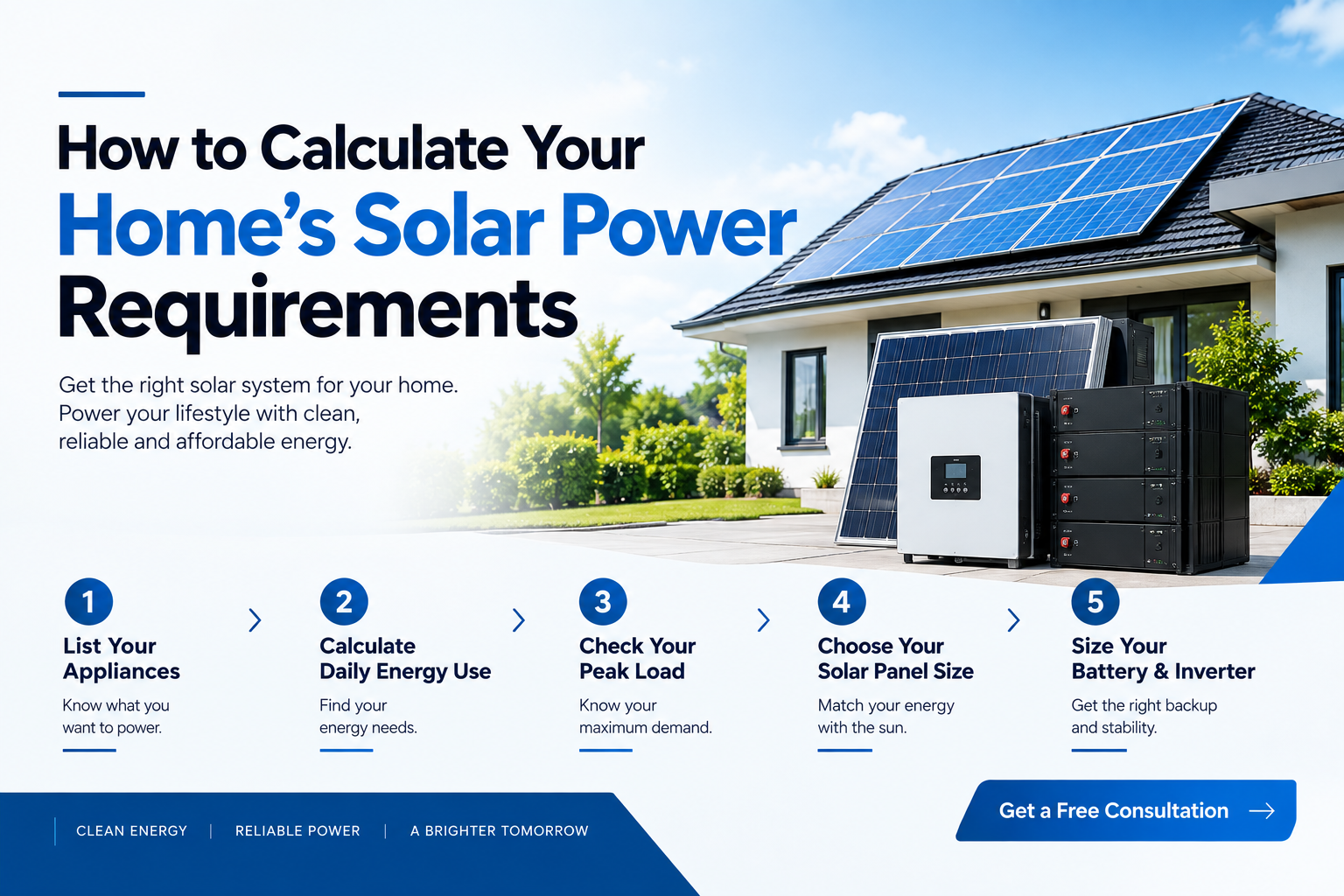
How to Calculate Your Home’s Solar Power Requirements
Solar power can provide reliable backup electricity for your home, reduce dependence on the grid, and help lower generator fuel costs. However, one of the most important steps before installing a solar system is knowing how much power your home actually needs.
Choosing a solar system that is too small can result in frequent power shortages and battery problems. Choosing one that is unnecessarily large can increase your installation cost.
In this guide, we explain how to calculate your home’s solar power requirements in simple steps.
1. Start by Listing Your Electrical Appliances
The first step is to make a list of the appliances and electrical equipment you want your solar system to power.
For example:
| Appliance | Quantity | Typical Power | Hours/Day |
|---|---|---|---|
| LED bulbs | 8 | 10W each | 6 hours |
| Television | 1 | 100W | 5 hours |
| Refrigerator | 1 | 150W | 10 hours* |
| Standing fan | 2 | 60W each | 8 hours |
| Laptop | 1 | 65W | 6 hours |
| Wi-Fi router | 1 | 15W | 12 hours |
*Refrigerators cycle on and off, so their actual energy consumption may be lower than their rated power multiplied by the full number of hours.
The power rating of an appliance is usually written on a label attached to the appliance. For more accurate calculations, you can also use a power meter to measure actual consumption.
2. Calculate Your Daily Energy Consumption
Once you have your appliance list, calculate how much energy each appliance uses per day.
The basic formula is:
Energy (Wh) = Power (W) × Usage Time (hours)
For example, if you have a 100W television that runs for 5 hours per day:
100W × 5 hours = 500Wh
The television therefore uses approximately 500 watt-hours (Wh) per day.
Repeat this calculation for each appliance and add the results together.
Example
Suppose your appliances have the following estimated daily consumption:
-
Lighting: 480Wh
-
Television: 500Wh
-
Refrigerator: 1,000Wh
-
Fans: 960Wh
-
Laptop: 390Wh
-
Wi-Fi router: 180Wh
Your estimated daily energy consumption would be:
480 + 500 + 1,000 + 960 + 390 + 180 = 3,510Wh/day
That is approximately:
3.51kWh per day
This figure gives you a starting point for sizing your solar system.
3. Determine Your Maximum Power Demand
Daily energy consumption is not the only thing that matters.
You also need to know the maximum amount of power your home may require at one time.
Add the wattage of appliances that may operate simultaneously.
For example:
-
Refrigerator: 150W
-
Television: 100W
-
Fans: 120W
-
Lights: 80W
-
Laptop: 65W
-
Router: 15W
Total running load:
150 + 100 + 120 + 80 + 65 + 15 = 530W
Your inverter must be capable of supplying this load.
However, some appliances—particularly refrigerators, freezers, pumps and air conditioners—can require significantly more power when their motors start. This is known as starting or surge power.
That is why you should not select an inverter based only on the total running wattage.
4. Choose the Right Inverter Size
Your inverter converts the DC electricity stored in your batteries into AC electricity that your household appliances can use.
A simple approach is to allow some additional capacity above your calculated maximum running load.
For example, if your maximum simultaneous load is approximately 2,000W, an inverter around 2.5kW or higher may be considered, depending on the appliance mix, starting loads and desired system configuration.
For homes with heavy loads such as air conditioners, water pumps, electric cookers or large refrigerators, the inverter calculation needs more careful consideration.
Important: Do not choose an inverter simply based on the total wattage of every appliance in your house. What matters is which appliances you expect to run at the same time and their starting requirements.
5. Calculate the Solar Panel Capacity You Need
Next, you need to determine how much solar panel capacity is required to produce your daily energy.
The calculation depends on several factors, including:
-
Your daily energy consumption
-
Available sunlight
-
Panel orientation and shading
-
System losses
-
Panel efficiency
-
Location and weather conditions
A simplified formula is:
Solar Panel Capacity (kW) = Daily Energy Requirement (kWh) ÷ Peak Sun Hours ÷ System Efficiency
For example, suppose your home uses approximately 5kWh per day.
If you use an assumed 4 peak sun hours and an overall system efficiency of 80%:
5 ÷ 4 ÷ 0.8 = 1.56kW
You would therefore need approximately 1.56kW of solar panels under these assumptions.
In practice, you would select an appropriate panel configuration above this minimum calculated figure to provide a reasonable operating margin.
6. Size Your Solar Battery
Battery capacity is especially important if you want your solar system to supply electricity at night or during periods when there is little sunlight.
A simplified battery-sizing formula is:
Battery Capacity (kWh) = Required Energy ÷ Usable Depth of Discharge
For example, if you need approximately 5kWh of usable energy and your battery system is designed around an 80% usable depth of discharge:
5 ÷ 0.8 = 6.25kWh
You would need approximately 6.25kWh of nominal battery capacity, before considering additional factors such as inverter losses, battery efficiency, temperature and battery ageing.
Battery sizing also depends on how many hours of backup you want.
A home that only needs essential appliances during power outages will require a different battery capacity from a home that wants to run most appliances throughout the night.
7. Decide Which Appliances Are Essential
One of the easiest ways to reduce the cost of a solar installation is to separate your appliances into essential and non-essential loads.
Essential loads might include:
-
Lights
-
Refrigerator
-
Fans
-
Television
-
Internet router
-
Security systems
-
Computers
-
Selected small appliances
High-power loads might include:
-
Air conditioners
-
Electric water heaters
-
Electric cookers
-
Irons
-
Water pumps
-
Washing machines
You don’t necessarily need to power every appliance from your solar system.
Creating an essential-load circuit can allow you to build a smaller and more affordable backup system while still maintaining the appliances that matter most during an outage.
8. Consider Your Future Electricity Needs
When calculating your solar requirements, don’t only consider what you use today.
Think about what you may add in the future.
For example, you may eventually install:
-
Another refrigerator
-
Additional fans
-
An air conditioner
-
A larger television
-
A water pump
-
More lighting
-
Home-office equipment
-
An electric vehicle charger
Planning for reasonable future expansion can prevent you from having to replace your inverter, batteries or other equipment later.
9. Don’t Forget System Losses
Solar calculations are theoretical starting points. Real-world systems experience losses.
Energy can be lost through:
-
Inverter conversion
-
Battery charging and discharging
-
Wiring
-
Temperature
-
Dust and dirt on panels
-
Shading
-
Other system components
This is why solar installations should include appropriate design margins rather than sizing every component to the absolute minimum.
10. A Simple Example of a Complete Solar Calculation
Let’s assume a home has an estimated daily electricity requirement of:
5kWh/day
The homeowner wants to run essential appliances during the day and use battery power at night.
Estimated requirements
Daily energy: 5kWh
Peak simultaneous load: 2kW
Solar resource assumption: 4 peak sun hours
Estimated system efficiency: 80%
Solar panels
Using:
5 ÷ 4 ÷ 0.8 = 1.56kW
A practical system would use an appropriate panel capacity above this calculated minimum.
Inverter
With a maximum expected running load of around 2kW, an inverter with sufficient continuous capacity and appropriate surge capability would be required.
Battery
If the system needs to provide 5kWh of usable energy and the selected battery configuration allows 80% usable capacity:
5 ÷ 0.8 = 6.25kWh
So the battery bank would need approximately 6.25kWh of nominal capacity, subject to the battery manufacturer’s specifications and the actual system design.
This is only an example. Your home’s actual solar requirements will depend on your appliances, usage patterns, location, available sunlight and desired backup time.
Common Mistakes to Avoid
1. Sizing based only on the inverter
A large inverter does not automatically mean you have enough solar panels or battery capacity.
2. Ignoring starting power
Motors and compressors can require additional power when starting.
3. Assuming every appliance runs continuously
A refrigerator, for example, does not normally operate at its full rated power continuously.
4. Ignoring nighttime consumption
If you want electricity after sunset, your battery needs to be sized accordingly.
5. Installing too little solar capacity
A system that cannot adequately recharge its batteries during available sunlight may provide disappointing performance.
6. Forgetting shading
Even partial shading can significantly affect the output of a solar panel array, depending on the system design.
Final Thoughts
Calculating your home’s solar power requirements involves more than simply adding up the wattage of your appliances.
You need to consider daily energy consumption, maximum simultaneous load, inverter capacity, solar panel capacity, battery storage, starting loads and system losses.
The right solar system should be designed around the way your household actually uses electricity.
At Jetgate Power, we can help you assess your electrical requirements and determine the appropriate solar, inverter and battery configuration for your home.
Explore our POWER CULCULATOR: Power Calculator – Detopsy Electrical Shop
Ready to plan your solar system? Contact Jetgate Power to discuss your power requirements and find a solution designed around your home’s needs.